8.1 Sumud, and the Resistance Against Slow Erasure
8.1 Sumud صمود, and the Resistance Against Slow Erasure
Resist To Exist - A common phrase used among Palestinians
“Resist to exist”, a phrase commonly heard among Palestinians, encapsulates the fundamental relationship between life and resistance under occupation. In a context where Palestinians are subject to surveillance, restriction, displacement, and even death, mere presence becomes defiance. The Palestinian body, then, is not just a target of settler-colonial violence but also a bearer of resistance. Through its continued existence, its movement through forbidden spaces, its refusal to leave, its capacity to endure pain and still perform care, the body asserts a political will to survive, to belong, and to remain.
In Chapter Five I described how the settler-colonial architecture of control in Palestine functions as a mechanism of slow erasure, designed to fragment the Palestinians, displace them from their land, and sever their historical and cultural ties. Militarised checkpoints, home demolitions, and the suppression of knowledge work together to erode identity and agency over time. While Palestinians are hyper-visible under surveillance, the state simultaneously seeks to erase them from the landscape and historical narrative. Chapter Six continued by looking at how the matrix of violence aims not only to curtail physical survival but also to erase historical continuity, cultural cohesion, and collective resistance. The slow erasure of identity unfolds through dehumanisation, isolation, and severing of social bonds. Yet, acts of resistance persist, through the survival of disabled bodies, the rejection of imposed narratives, and the preservation of memory despite enforced forgetting. Palestinian identity endures, resisting erasure even in the face of settler-colonial domination.
The story of the Amer family, whom we met in Chapter Five, has become widely known in Palestine as a testament to their enduring resistance against the settler-colonial occupation and its absurd architecture. This architecture is rooted in spatial and temporal forms of violence that oppress Palestinians. Following their forced displacement during the Nakba, the family became refugees, uprooted from their village, only to find themselves confronted by the ongoing settler-colonial project. Their refusal to leave their home became an ongoing act of resistance, challenging the erasure they faced. However, this passive and peaceful resistance also exposes the Amers to vulnerability as they confront settler attacks on their house, a heavily armed Israeli military, the surveillance techniques, and the constraints and limitations imposed by the enclosing architecture. Kevin D. Haggerty (Haggerty 2006)1 argues that while surveillance regimes are initially designed with specific intentions, they often result in unintended outcomes due to their flexible and innovative use. These deterritorialised forms of social control are challenging to secure and control, leading to the emergence of resistance that is inherent to the system itself (Bogard 2006)2.
Faced with the decision to have their house demolished and becoming refugees once again, their decision to remain on their property was an act of resistance, albeit a challenging one.
The resistance embodied in the Amer family’s struggle is both physical and symbolic, reflecting a broader defiance against the slow violence of settler-colonial expansion. Their decision to remain in their home, despite the overwhelming pressures imposed by military and settler aggression, represents a steadfast refusal to be erased from their land. The small yellow gate, which the Amers fought to have installed as the only access point to his home, is a tangible testament to this resistance, an assertion of agency within a system designed to limit Palestinian movement and dispossession. The mere act of staying, of continuing daily life within the walls of an ever-shrinking space, challenges the Israeli state’s objective of slow erasure.
This resistance is not limited to physical presence; it is also a form of psychological endurance against a systematic campaign of intimidation and deprivation. The destruction of greenhouses, the relentless night raids, the loss of agricultural land, and the ever-present surveillance all serve as tools of coercion, pressuring the family to leave. Yet, by remaining, the Amers challenge the very logic of this settler-colonial project, exposing the absurdity and cruelty of its methods. Their continued presence, amidst the violence of the wall, the military, and the settlement, becomes a powerful act of defiance against a system intent on their erasure.
This daily struggle for existence, marked by both material deprivation and psychological endurance, is not unique to the Amer family but resonates across the broader Palestinian experience. The pressures of occupation manifest in countless ways, shaping lives and narratives far beyond the confines of a single household. One entry in my research journal recounts an evening in Ramallah, sitting with friends, when one of my Palestinian companions shared a story about a young man who had been pursued by Israeli soldiers:
When the Israelis caught him, they tried to force him into a military jeep, but he managed to delay the kidnapping a bit by arguing. At that moment, seemingly out of nowhere, a young Palestinian woman appeared carrying an infant. She approached the vehicle, shouting at the young man as if accusing him of abandoning her and the baby. Before anyone could grasp what was happening, she handed the baby to the young man and disappeared as quickly as she had come. The soldiers were clearly confused. Under other circumstances, they would have been quick to arrest the young man, but it seemed they had a limit to their willingness to use force, especially when it involved a child. With no one else around, they had little choice but to let the young man and the baby go. As the young man walked away, carrying the baby, he soon met up with the infant’s mother. He returned the baby to her, and it turned out they weren’t related at all. (Research journal, 2019)
This brief yet powerful episode speaks to the ways in which Palestinians preserve their identity and agency under occupation. The young man, though caught, resisted by refusing to comply immediately, while the woman actively intervened to disrupt the soldiers’ authority. Their actions demonstrate a sophisticated form of resistance, one rooted not only in defiance but also in trust and collective understanding. The woman entrusted her baby to a stranger to save him, and the man, despite the risk, instinctively accepted the role she assigns him. This unspoken coordination suggests a deeper communal consciousness, a kind of resistance that does not require verbal agreement but is instead embedded in shared experience. It is precisely this ability to move in synchrony, to recognise and respond to each other’s cues, that threatens the occupier.
A gendered reading of the event further reveals how both individuals strategically manipulated the expectations placed upon them. The woman exploited the soldiers’ assumptions about Palestinian motherhood, knowing that her presence with a baby will create hesitation. The man, in turn, stepped into the role of a father figure, a role that momentarily shielded him from immediate violence. Here, gender is not just a social category but a tool of resistance, a means of subverting the logic of occupation.
The baby, too, becomes central to this act of resistance, not as an active participant, but as a silent body placed at the heart of the encounter. As an infant, the baby lacks speech and agency, yet its presence dictated the soldiers’ hesitation. This moment also invites a broader reflection on care, who is caring for whom in this story? The woman appears to protect the man, the man carries the child, and yet the entire event reflects a form of collective care that extends beyond individual relationships. Sumud, then, is not merely about endurance; it is also about the enactment of care within a besieged community. Resistance in this context is not only about defying oppression but about ensuring that acts of trust, protection, and solidarity continue to flourish despite it.
Abdel Fatah Abu Srour, director of the cultural NGO al-Ruwwad in ‘Aida refugee camp, explains Sumud as “continuing living in Palestine, laughing, enjoying life, falling in love, getting married, having children. Sumud is also continuing your studies outside, getting a diploma back here. Defending values is sumud. Building a house, a beautiful one and thinking that we are here to stay, even when the Israelis are demolishing this house, and then building a new and even more beautiful one than before – that is also sumud. That I am here is sumud. To reclaim that you are a human being and defending your humanity is sumud.” (as quoted in Rijke and van Teeffelen 2014, 90)3. As the Zionist project, rooted in the settler-colonial logic of elimination, aims to erase any and every Indigenous part from the land it has invaded, being alive, as the quote at the beginning of this chapter highlights, becomes an act of resistance. Sumud represents a deliberate decision rather than an imposed obligation to remain on the land and resist occupation while preserving cultural traditions and heritage. Sumud is also present in the multiple generations of Palestinians living as refugees worldwide, where culture, language and history are passed down, keeping the rootedness with Palestine and the Palestinian land alive. Across different spaces and circumstances, Palestinians continue to resist erasure, whether through daily acts of survival or through the collective preservation of their heritage.
During fieldwork for my Master’s thesis in 2015 (a trip that also coincided with my mother’s 60th birthday), I noted in my journal an encounter with a large group of Palestinian women gathered under the shade of an olive tree on Haram al-Sharif in Jerusalem. These women, as I soon discovered, were members of the Murabitat, a group dedicated to protecting Al-Aqsa Mosque, one of Islam’s holiest sites, from right-wing Jewish incursions entering the mosque with shoes and guns, much like how Arial Sharon started the Second Intifada (see Chapter Three). The Al-Aqsa Mosque in East Jerusalem is the third-holiest site in Sunni Islam, following Masjid al-Haram in Mecca and Al-Masjid an-Nabawi in Medina. Many Muslim residents of Jerusalem feel a profound duty to protect this sacred site, a commitment known as ribat.
About five minutes into our conversation, the women suddenly began shouting. Taken by surprise, it took me a moment to grasp what was happening. A group of Israeli settlers, escorted by heavily armed guards, had entered Haram al-Sharif (see Figure 11).
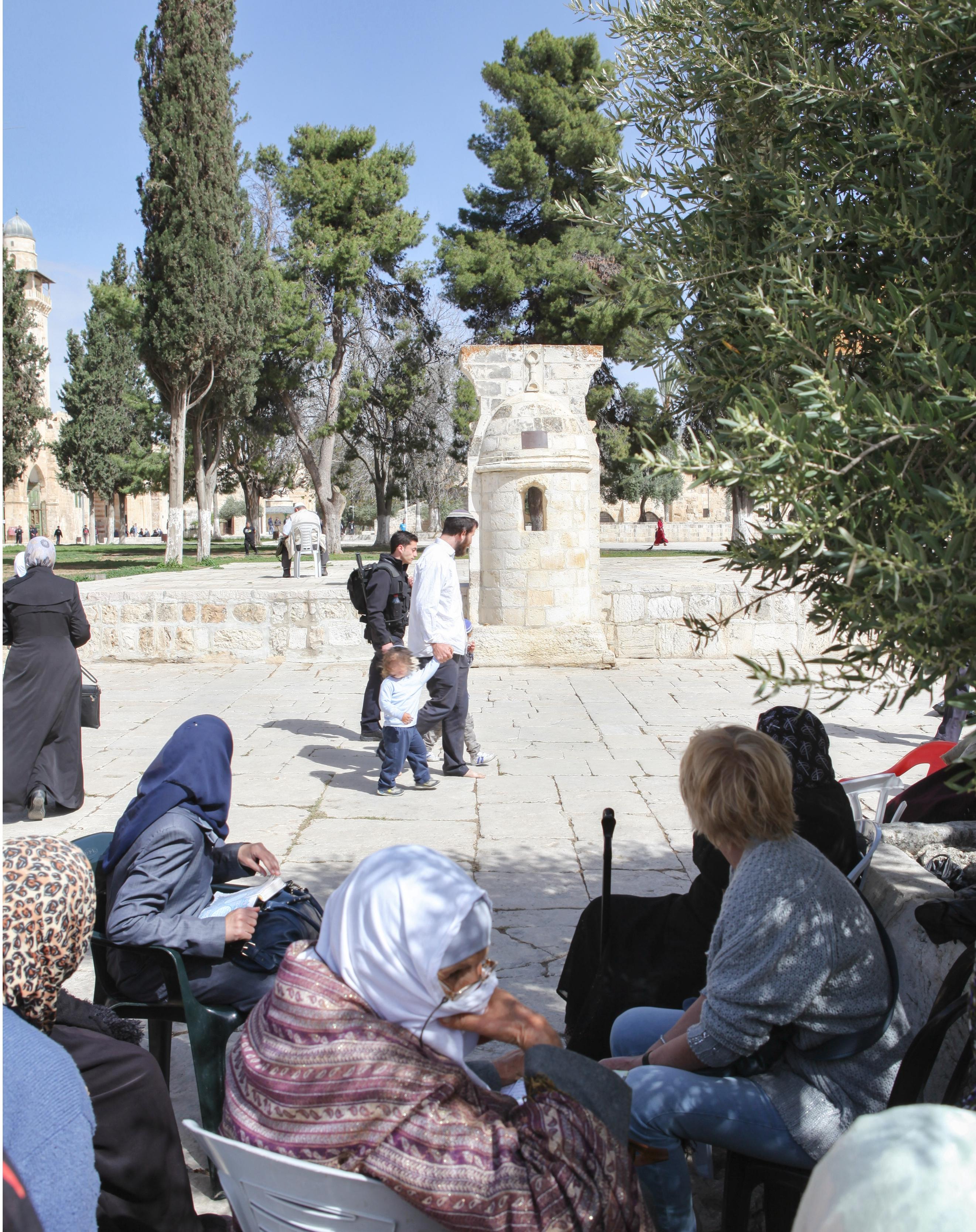 Figure 11. Some of the Murabitat (not to be confused with my blonde mother) guarding the Al-Aqsa Mosque, yelling at the Israeli settlers and their armed escort. Photo by author, child’s face blurred on purpose.
In an interview featured in the book Our vision for liberation: engaged Palestinian leaders and intellectuals speak out by Bārūd and Pappé (Bārūd and Pappé 2022)4, Hanadi Halawani, a long-time leader of the Murabitat, describes the resilience and determination of the women involved in the movement. She recounts: “For a while, they used the tactic of stealing our chairs. So, we replaced the chairs with rugs. They stole the rugs, too, so we sat on the bare floor. The effort of these Murabitat, the steadfast women, forced the extremists to change the path of their raids by conducting symbolic visitations where they would enter from the Moroccan Gate and quickly leave from the Chain Gate without desecrating much of the compound, as they had always done.” (Halawani 2022, 166--67)5. Hanadi says she gets her strength from her grandmother:
I remember her many stories about war, always rife with a mixed feeling of agony and hope of an assured victory … I feel that my grandmother’s heart is beating in my chest and that I am a mere messenger, carrying her message to the world. My grandmother’s legacy has taught me that when you plant a seed, do not worry if you are not the one who eats from the fruits it bears. Our fight for freedom is inter-generational—my grandmother planted a seed in my heart, and I am planting the seeds in my children’s hearts. The more I carry on with my fight for freedom, the more courageous I feel, the more unmoved, unafraid. (Halawani 2022, 166--67)5.
Through their actions, the Murabitat, a term that conveys their steadfastness and dedication to their cause, embody an identity rooted in their role as protectors and defenders of the Al-Aqsa Mosque, a symbol of Palestinian identity and resistance against Israeli occupation. Their identity is also deeply tied to their religious and cultural heritage, which they see as intertwined with the land of Palestine, particularly Jerusalem. Hanadi’s identity is further shaped by her lineage, specifically her grandmother’s experiences and stories of the Nakba and Naksa, which instilled in her a sense of responsibility to continue the struggle for Palestine. However, the settler-colonial administration started with a crackdown against the resistance.
Hanadi Halawani and her peers’ actions can be interpreted as an assertion of their agency by engaging in actions around Al-Aqsa and directly confronting the Israeli military and settlers through peaceful yet defiant actions. Their sumud is further demonstrated in their ability to adapt to repression, such as relocating their activities when access to the mosque is denied or continuing their activism despite arrests, deportations, and physical abuse. They exercise their agency in physical resistance and the symbolic realm, using education, religious teachings, and communal solidarity as resistance tools. This agency extends beyond local activism to international advocacy, as Hanadi seeks to bring the message of the Murabitat to global forums (Bārūd and Pappé 2022)4.
References
-
Haggerty, Kevin D. 2006. "Tear down the Walls: On Demolishing the Panopticon." In Theorizing Surveillance: The Panopticon and Beyond, edited by David Lyon. Willan Publishing. ↩
-
Bogard, William. 2006. "Surveillance Assemblages and Lines of Flight." In Theorizing Surveillance: The Panopticon and Beyond, edited by David Lyon. Willan Publishing. ↩
-
Rijke, Alexandra, and Toine van Teeffelen. 2014. "To Exist Is To Resist: Sumud, Heroism, and the Everyday." Jerusalem Quarterly, no. 59: 86--99. https://doi.org/10.12968/bjha.2015.9.10.477. ↩
-
Bārūd, Ramzī, and Ilan Pappé, eds. 2022. Our Vision for Liberation: Engaged Palestinian Leaders and Intellectuals Speak Out. Clarity Press. ↩↩
-
Halawani, Hanadi. 2022. "We Are the Murabitat: Planting the Seeds of Resistance in Occupied Jerusalem." In Our Vision for Liberation: Engaged Palestinian Leaders and Intellectuals Speak Out, edited by Ramzī Bārūd and Ilan Pappé. Clarity Press. ↩↩